Tuesday, December 7, 2010

DC: A capital place for birds - Part II


My last day of exploring the wildlife of DC was spent leisurely wandering around Theodore Roosevelt Island. A national monument and delightful natural area literally packed with birds and wildlife. Almost as soon as I crossed the bridge onto the island I started hearing birds in the surrounding trees. I quickly found myself in the middle of a mixed flock of birds, dizzily trying to spot, identify and photograph as many as I could. Walking through a wood can be akin to traversing an avian desert with sightings few and far between, when you hit the oasis of a mixed flock, it is a moment to be savoured. My first bird of the day was a ruby-crowned kinglet, although you'd be hard pressed to tell from the this arse-shot, a photographic style in which I consider myself a master.


Next up was a Carolina Chickadee, a life bird for me and a somewhat challenging one to be sure I had really seen for the first time. The reason being that the carolina chickadee looks almost identical to the Black-capped Chickadee more frequently seen back home in Michigan. The Carolina has a "neater" looking black throat bib on average and more uniformly shaded underparts, while the Black-capped has white fringes to many of its wing feathers, particularly the greater coverts (although these will fade as the feathers wear between molts). Perhaps these things are apparent to a more experienced observer than I, but on my first viewing I would have been lying if I said I was confident based on visual observation only. Thankfully, they have quite distinct vocalisations, the onomatopoeic "chick-a-dee-dee-dee" call associated with the Black-capped is repeated similarly but faster and with a higher pitch by the Carolina. Even more informative is the song; I could distinctly hear a 4-note song "fee-bee-fee-bay" which is readily distinguished from the "fee-beee" of the Black-capped. A couple of shots of this enjoyable study:


There were plenty more of the regular woodland birds I was used to seeing: Northern Cardinals, Tufted titmice, Downy woodpeckers, White-breasted nuthatches, etc. As I continued round to the north of the island I was startled by the eruption of feathers as a Great Blue Heron took off in fright close to my feet. As I watched the huge bird lazily flap its way out of sight my attention was arrested by a flock of ring-billed gulls and I continued my study of their different plumage stages and watched their feeding squabbles with amusement. 


Further on around the island the deciduous woodland gave way to a significant area of mixed marshland and scrubby bushes and smaller trees. As I scanned the area looking for any number of birds I was hoping for, most especially a red-shouldered hawk, I came across a most bizarre sight. Birds are forever giving us reason to ponder their grace and skill with their mastery of arial propulsion, but occasionally the risks of defying gravity are also made apparent. Finding a Canada goose hanging by its neck from a tree fork stuck me at first disturbingly like a suicide attempt. Inappropriate anthropomorphisms aside, it's surely more likely this unfortunate goose was startled by a noise, or predator, at night and in the confused collided with a tree, falling into this unlikely position. I suppose it may also have simply amused somebody to place the goose like this, but it was not in a particularly obvious location for a practical joke.  


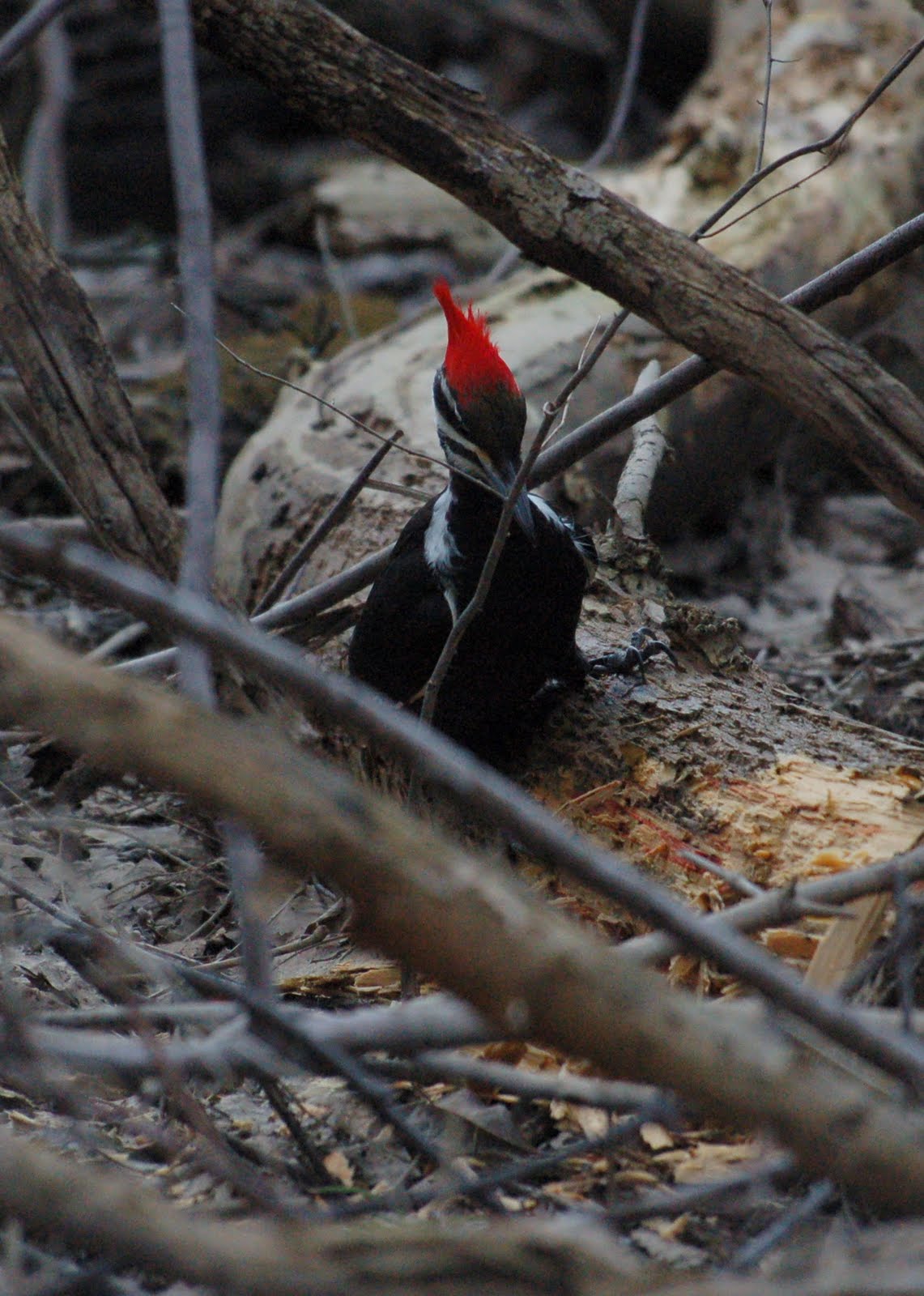
Shortly after the pendulous medication of the canada goose, a flash of red on a crow-sized bird alerted me to the flight of one of my all-time favorite birds, the Pileated Woodpecker. It doesn't matter how many times I see this magnificent bird, it always stops me in my tracks. This handsome individual below is a female, a male would have the red head crest extending down all the way to the bill, the malar stripe (extending back from the bill) would also be red on a male. She was a most obliging individual, so engrossed in foraging on a rotten log that she seemed completely oblivious to me, affording a luxuriously long viewing of a bird I have normally found irritatingly skittish. 


Crossing the bridge back to Georgetown from the island I was distracted by the sight of a bald eagle soaring high above the Potomac river. It seemed a fittingly poetic end to a day of birding in the nation's capital. The birding was not over however, the day held one more surprise in store. As I was watching the Bald Eagle I noticed an extremely familiar silhouette fly by at speed in my periphery vision. Sure enough, a Peregrine Falcon was chasing pigeons and putting on the kind of incredible arial display that few other birds could match. The views of the Peregrine in flight were matchless. Unfortunately my photography was not; the combination of proximity and speed, while so vicerally impressive, completely baffled my skills and I didn't manage to get the bird in focus even once. It was such a key part of my birding experience that day that I'll leave you with a blurred photo regardless, I like to think it at least gives an impression of speed. 


Wednesday, December 1, 2010

Saturday, November 27, 2010

DC: A capital place for birds - Part I

At the beginning of March this year I took a weekend trip to Washington DC. We'll deftly ignore how long it has taken to get around to writing a blog post, I'm sure no one has noticed anyhow. The plan was simple: explore a new city, hang out with various friends and last but not least search out the avian inhabitants of DC. I was excited to hike and explore in an environment that contained so many birds that had been absent for many months back up north in snowy Michigan. Many, but not all, of the birds I was likely to see would be familiar sightings in Michigan in a few months time but hell I missed them. 

I started off my tour of DC at the white house; it seemed the appropriate thing to do. After confirming it was indeed a house and that it was also white I was able to switch my attention with a clear conscience to the local wildlife. One of the great things about living in an area with as clearly defined seasons as Michigan is that birds that can very easily become so familiar that you no longer really notice them become special once again every year after their prolonged winter absence. This really became a reoccurring theme during my DC trip. I spent a lot of time noticing how beautiful so many of last years "trash" birds really were. Michigan's state bird, the american robin, was the first bird to catch my eye. I think I harboured some unconscious resentment toward the american robin simply because some dimwit had decided it had a red breast like the European robin. However, seeing them again with fresh eyes I was quite taken aback by their subtle beauty.


Wandering around the National Mall an American widgeon. The picture below shows a male in breeding plumage. This is another bird that can seem dull from a distance but when viewed up close shows a delightful patchwork of plumage detail. It isn't clear from this photo, but viewed head on, the blonde mohawk with the green "eye-shadow" gives it quite the 80's pop rocker appearance. 


In the spirit of appreciating the beauty of birds that are seen so often they can become almost invisible, surely none is so apt as the Mallard! There is a temptation to become so fixated on the rare, or novel, birds, that we fail to appreciate the beauty we see almost daily. The male mallard is spectacular: iridescent head feathers, stylishly curled tail feathers, bright yellow bill, white neck ring, chestnut chest, and stunning white bordered, blue speculum (brightly coloured square of secondary feathers on the wing) on a grey background. Here a fine example is shown, suavely displaying to the females with the old leg-behind-the-ear maneuver (or perhaps simply scratching an itch I guess) that all men have used at one time or another. 


Sometimes the occasion calls for putting on a more regal air, and, I think you'll agree, the mallard pulls this off with aplomb.


Although, they can rarely keep a straight face for long.


Another so called "trash" bird that is fairly ubiquitous over much of the USA is the ring-billed gull. Once again, a closer look provides stacks of interest. These birds progress through four different molts before settling into an annual rhythm where they alternate their summer breeding plumage with their winter "dress-down" plumage. This makes identifying gull species difficult enough, but when you factor in individual variation, partially molted birds, hybrids between different species of gull you can see that is a potential minefield for even the most experienced birders. It also means that if you are to have any chance at picking out a rare, or unusual, gull you are going to need to be extremely familiar with the many life stages of the common gulls in your area. In the mid-west, where I'm currently located, this means spending quality time with the ring-billed and herring gulls; species may vary for your location. 

The following picture shows a young ring-billed gull using its wings to abruptly reduce its speed as it comes in to land. This is most probably a 1st winter plumage ring-billed gull judging by the bicoloured bill; pink with a black tip, dark coloured secondary feathers and wing coverts and dark eye. 


Other commonly viewed birds that can be disarmingly beautiful when studied are the canada geese. They are extremely graceful birds in flight considering their size.


One bird I had been particularly hoping to spot during my visit to DC was the fish crow, a bird not typically found in Michigan. The fish crow is extremely hard to distinguish from the virtually identical-looking american crow and it is usually necessary to hear it vocalize to confirm its identity. At the time I took this photograph this bird was being irritatingly silent, almost certainly on purpose, keeping me on tender-hooks as I waited to see if this would be my first view of a fish crow. Thankfully, it eventually took flight, calling as it did so with what the guide books describe as a two-toned "ca-hah", but what sounded suspiciously like F#*k off to me!


This red-winged blackbird was a welcome sight after a long Michigan winter. One of the first migrants to arrive in the spring, it seems to usher in the warming temperatures and greening of the land that shortly follow. Its strange gurgling, tremulous call also seemed a fitting herald of the year had to offer. I will be honest here, just a few weeks later when the continual, unrelenting calls of the red-winged blackbird were drowning out the sound of all other birds, it did start to grate (just a little). The red/yellow "epaulet" on the birds shoulder can be hidden or flared conspicuously as required. The blackbirds use it for communicating, among other things, whether they are defending their home territory or just passing through. In the densely populated breeding colonies this kind of distinction is important for minimising potential conflict between breeding males. 


A description of a walk through the Constitution Mall would be incomplete without some mention of the "killer" grey squirrels that abound. No matter how cute they might look, keep your guard up, they are just waiting for an opportunity to rip your throat out. That's a little known fact that applies to all members of the squirrel family. I think the last picture captures the psychotic glint in the eye of this urban killer best as it chews on polystyrene eyeing my jugular. 


The habituation of the birds encountered in the parks of DC was a real treat. This red-tailed hawk was sitting literally 10 ft above a walkway looking entirely unconcerned about the crowds of people milling about below. Although these hawks are common right across the US, I've always found them to be nervous and skittish when perched. To see one this close was, in the original sense of the word, awesome!


Continuing to ponder those hidden jewels hidden right under your nose, have you ever stopped to look at some of those "boring" black birds you see all the time and suddenly you notice, or are reminded, that their feathers are actually iridescent presenting a complex array of hues, constantly changing as they shift position. This common grackle is a case in point; purples and blues give the impression of light off an oil slick on this birds plumage. 


Once I had been primed by the grackle it was only a matter of time before the ubiquitous starling's iridescent plumage also caught my eye. Here a seemingly uniform black colouration can produce purples and greens under the right light. 


This grumpy looking individual also reminded me rather strongly of a womble.


I eventually left the mall and headed out to Hain's point to see if I could find anything out on the water. The first bird I spotted was a great black-blacked gull, the largest gull in the world. With a wingspan in excess of 5ft this is always a magnificent bird to watch, a real pleasure. 


Surprisingly, while Hains point didn't yield much in the way of waterfowl it was surprisingly productive birding regardless. A flock of white-throated sparrows first caught my attention, flittering through the underground, their distinctive song seemingly coming from all directions.


Shortly after I got my first good look at a mockingbird. I didn't get to hear any of its famous and repetitive mimicry but it hung around and provided some great views. 


After walking the length of Hains point and seeing very few of the birds I had hoped to find conveniently floating in the Potomac I headed back. For a moment, I was feeling slightly dejected about missing some key birds, then I happened to catch a glimpse of an "interesting" silhouette in my periphery vision. An absolutely glorious view of a male merlin conveniently perched up, just to the side of the trail. Just like that, my day was made. 


Not two minutes after I had reluctantly left the merlin to his hunting, I stumbled across this red fox nonchalantly trotting across the golf course. I know these animals are famous for their ability to adapt to life in an urban environment, but it is still always a very pleasant surprise to see them in the middle of a big city. 


Finally, as a approached the Jefferson memorial I noticed some shapes in the trees on the opposite side of the river. They were clearly bird-like and if anything, looked vaguely owlish, although the fact that there were 15 to 20 of them made that seem fairly unlikely. My curiosity piqued, I made my way across the nearest bridge and then spent a few minutes trying to figure out a way to get close to the river. Eventually an abandoned car lot, and some broken fencing allowed me to get close enough to see my first black-crowned night herons. A colony of them were perched up, hunched over and glaring at me balefully with their bright red eyes. The thick tangle of branches made my attempts to photograph them mostly ineffectual, but a fun spot find nonetheless. 


I finished off the day with a trip to the Smithsonian museum, which was quite brilliant. Heading home for the night I was treated to some final feathery treats. A cooper's hawk perched surprising low in a bush was fiercely observing the unobservant pedestrians walking past, entirely ignorant of his presence. As I peaked into some promising looking habitat just outside the National museum of American Indian I received my final two treats of the day. Firstly, my first view of a swamp sparrow, with his jaunty check patches popped up and entertained me for a while. 


Shortly followed by this winter-plumage myrtle warbler (formally known as the yellow-rumped warbler and lovingly called "butter-butt" by its friends). Light was fading fast at this point, so at this shoddy photograph I reluctantly called it a day. 


Wednesday, November 17, 2010